
On the afternoon of April 14th, Chinese President Xi Jinping held a ceremony at the east gate of the Great Hall of the People to welcome the President of the Federative Republic of Brazil, Luiz Inacio Lula da Silva, on his state visit to China.
President Xi Jinping’s wife, Peng Liyuan, Wang Yi, a member of the Political Bureau of the CPC Central Committee and Director of the Office of the Foreign Affairs Work Committee of the Central Committee, and State Councilor Qin Gang attended the welcoming ceremony.
Accompanying President Lula’s visit to China were the First Lady, the President of the Senate, the Minister of Foreign Affairs, and the Minister of Finance.
Lula’s visit to China is significant for several reasons.
Firstly, it highlights the growing importance of the China-Brazil relationship, as both countries seek to strengthen economic and political ties. Brazil is one of the largest economies in Latin America and a key player in the region, while China is the world’s second-largest economy and a major global power. The two countries have been working to deepen their cooperation in areas such as trade, investment, infrastructure, and technology.
Secondly, Lula’s visit to China sends a message of solidarity and cooperation between developing countries. Both China and Brazil are emerging economies that have faced similar challenges in terms of poverty reduction, economic development, and global governance. By strengthening their partnership, they can work together to address these challenges and promote a more equitable and sustainable world order.
Thirdly, Lula’s visit to China reflects Brazil’s desire to diversify its foreign relations and reduce its dependence on traditional Western partners. Over the past few years, Brazil has sought to expand its economic and diplomatic ties with countries like China, Russia, and India, in order to reduce its vulnerability to external shocks and enhance its geopolitical influence.
Overall, Lula’s visit to China represents an important milestone in the China-Brazil relationship and a significant step towards closer cooperation between the two major developing countries.
On March 25th, the press secretary of Brazilian President Luiz Inácio Lula da Silva announced that due to medical reasons, his highly anticipated trip to China had been canceled and rescheduled for a later date. Lula, who had just taken office earlier in the year, was diagnosed with bacterial pneumonia caused by H1N1 flu and had already begun treatment.
Meanwhile, the Brazilian business delegation’s trip to China signed more than 20 cooperation agreements, covering exports, investments, and comprehensive internationalization, with investment fields including traditional energy, renewable energy, and infrastructure. The main content included:
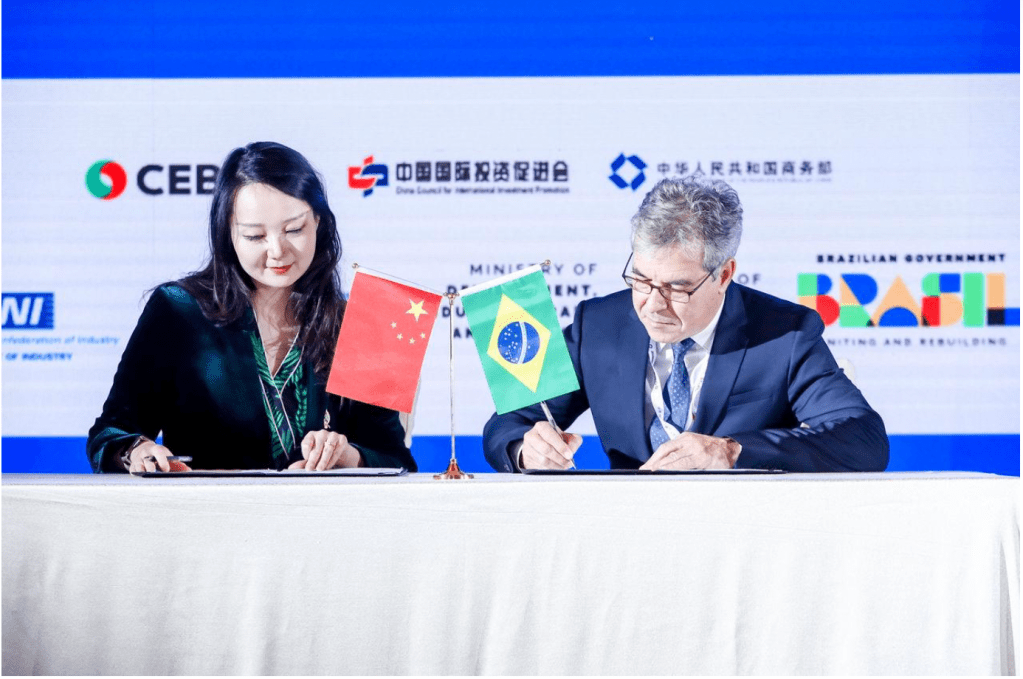
–Finance and Investment :
1)Banco BOCOM BBM announced its participation in CIPS(China International Payment System, which is China’s alternative to Swift. It is expected to reduce the cost of commercial transactions by direct exchange between the Brazilian real and the Renminbi. The bank will be the first direct participant in this system in South America.
2)ICBC Brazil became the Brazilian RMB clearing bank with the aim to further promote bilateral trade and RMB investment facilitation by relaxing the restrictions on the use of RMB.
3)Vale signed two agreements with Chinese banks, ICBC and Bank of China, involving comprehensive credit lines for Brazilian mining and global large-scale projects, as well as other financial partnerships, especially green financial cooperation, to strengthen green energy projects.
4)Motrice Energy Solutions and China Gansu International Economic and Technical Cooperation Group (CGICO) signed a memorandum of understanding in the renewable energy field, focusing on the import and implementation of services and investments.
–Innovation and Sustainable Development:
5)Announced the launch of an innovation center in Shanghai’s Zhangjiang Science City.
6)BMV Global, a Brazilian company, reached two agreements with Chinese companies on the commercialization of biodiversity credits. One is a collaboration with HRH (Chongqing) to promote sustainable trade and services and launch the Sino-Brazilian biodiversity credit trading platform. The second is a partnership with HRH Pharmaceutical to obtain biodiversity credits as its compensation mechanism for environmental impact and to obtain the BMV Sustainability Seal for good ESG practices.
7)Vale Indonesia also signed an agreement with Tisco (Baowu Group) and Xinhai Investment to build an RKEF nickel processing plant and other supporting facilities. The project has low carbon potential and will use natural gas energy. To strengthen green energy projects.
Vale’s initiatives:
8)Technical knowledge exchange with Tsinghua University; Conduct low-carbon steelmaking scientific research with Central South University (CSU).
9)Signed a Memorandum of Understanding with China Forestry Group to cooperate in the fields of bio-based materials and carbon, as well as investment and R&D.
10)Signed the fourth biochar production and application cooperation agreement with Baosteel (a subsidiary of Baowu Group), aiming to provide decarbonization solutions for the steel industry.
11)Mining giant Vale has announced an agreement with Chinese construction equipment manufacturer XCMG to develop the world’s first “zero carbon dioxide emissions” bulldozer. If successful, Vale’s bulldozer fleet will be migrated in the coming years.
12)Pulp company Suzano has signed three agreements with Chinese partners, including cooperation with COSCO to build 17 pulp and bio-based product transport ships, cooperation with a Chinese paper company, and the launch of an innovation center in Zhangjiang Science City in Shanghai.
13)Odebrecht, Power China and Sete Partners are collaborating on infrastructure projects in Brazil.
14)Sete Partners has partnered with Tianjin Food Group to establish a multinational company aimed at expanding investment in Brazil’s agricultural industry.
15)Odebrecht Engenharia e Construção, Power China, and Sete Partners have formed a partnership to provide joint solutions for infrastructure projects in Brazil.
16)Cooperating with COSCO, we will build five ships to transport cellulose and bio-based products, including long-term transportation contracts.
In recent years, “decoupling” policies have mainly targeted the dominance of the US dollar, leading to a road of mutual support and progress. Since 2009, China has been Brazil’s largest trading partner and one of its main sources of investment. In 2022, trade flow reached a record-breaking $150.5 billion, with Brazil exporting $89.7 billion and importing $60.7 billion.
In 2021, China became Brazil’s eighth largest investor (and Asia’s largest investor), surpassing Japan, South Korea, and India. Chinese foreign direct investment (FDI) stock in Brazil grew by $7.1 billion in 2021, a 31% increase from 2020, and total investment stock was nearly $23 billion. From 2012 to 2021, Brazil’s FDI stock in China grew by 114%, highlighting the increasing importance of growing Asian countries as destinations for Brazilian companies’ internationalization.
According to 2021 Sino-Brazilian trade data, primary products accounted for over 90% of Brazil’s exports to China, with “mineral products” such as iron ore and oil as the largest category of goods exported to China. “Plant-based products” such as soybean and wood pulp were the second largest category of goods exported to China, followed by “animal-based products” such as beef and chicken.
In other notable data, China’s General Administration of Customs announced on Friday that exports in 2022 grew by 7% to a record high of $3.59 trillion, exceeding the previous record of $3.36 trillion in 2021. Imports in 2022 grew by 1.1%. According to data from Wind, this means a trade surplus of $877.6 billion for the year, surpassing the previous record high of $676.43 billion in 2021.
The US Department of Commerce released data showing that the US trade deficit reached a record high of $948.1 billion in 2022. The data reveals that the goods and services trade deficit surged 12.2% to $948.1 billion in 2022 compared to 2021. Exports increased by 17.7% to $3.01 trillion, while imports grew by 16.3% to $3.96 trillion. The goods trade deficit increased by 9.3% to $1.19 trillion, while the services trade surplus decreased by 0.6% to $243.7 billion.
The Brazilian Ministry of Development, Industry, Trade, and Services released data showing that the country’s trade surplus reached a record high of $62.3 billion in 2022, the highest since record-keeping began in 1989. The data reveals that Brazil’s total exports in 2022 were $335 billion, a 19.3% increase from the previous year, while imports were $272.7 billion, a 24.3% increase from the previous year, both hitting new highs. The main factor driving Brazil’s trade surplus in 2022 was the increase in international commodity prices. Brazil’s exports increased by 5.5%, with average export prices rising by 13.6%, while imports increased by 2.6%, with average import prices rising by 23.4%.
As one of the “BRIC” countries, Brazil is eager to establish its international position in the new industrial era, which requires a secure foundation in energy, infrastructure, and basic industries. As an agricultural and mineral-rich country, exporting resources alone is not a long-term solution to its problems, and the highly uneven development of its industry has long plagued the country. The large number of agreements signed with China this time can not only promote Brazil’s rapid development but also alleviate domestic poverty and wealth disparities by driving employment and education.
As for the European and American countries that have been doing business in Latin America for many years, they naturally do not want to see this scene, but they really don’t have a solution.
 US-China Relations Updates
Leave a comment