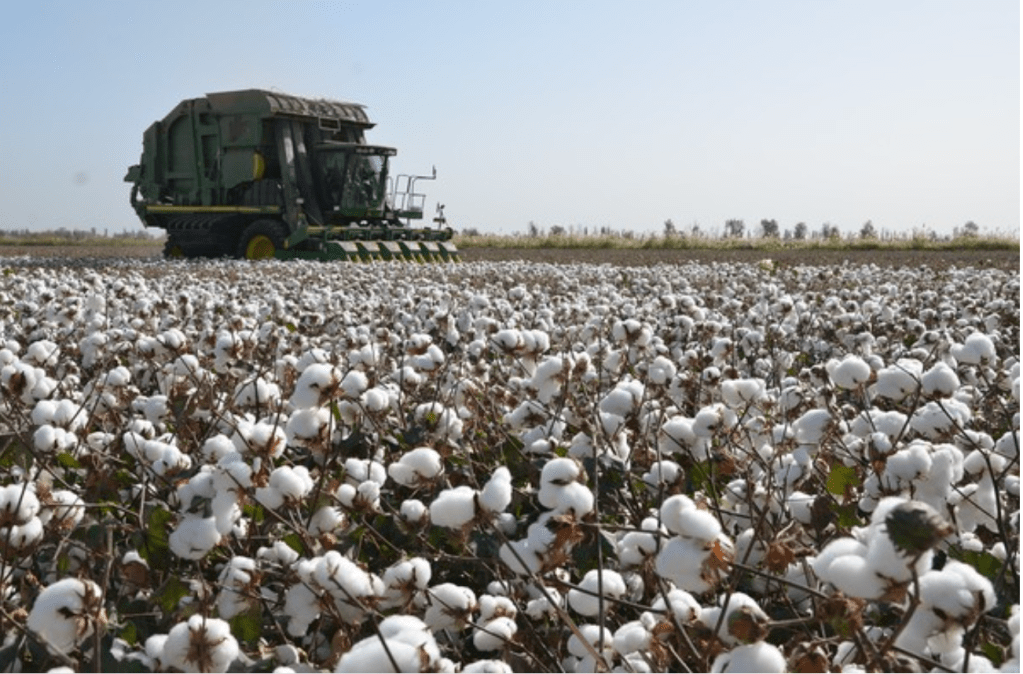
The wheat in Xinjiang does not involve “forced labor,” nor does the corn, sorghum, or soybeans. So why does cotton in Xinjiang specifically involve “forced labor”?
China’s wheat, corn, sorghum, and soybeans require many imports, with the US being the leading importing country, especially for soybeans. It would be foolish for the clever and cunning American politicians and businessmen to target “them” (the other crops). They would not make such a low-level mistake or engage in a foolish act.
The reason why the United States did not sanction Xinjiang’s food crops but targeted its economic crop “cotton” with harsh measures, even deadly ones, is due to deep historical reasons and practical purposes. Behind all of this is the United States’ hidden agenda, which is retaliation against China’s monopoly on domestically produced pest-resistant cotton seeds and planting, and a plot to destroy China’s cotton planting and related industries.
In 1986, the largest seed company in the United States, Monsanto, developed a genetically modified pest-resistant cotton. China wanted to introduce the variety at the time, but the other side demanded a sky-high patent usage fee of 90 million U.S. dollars. The country abandoned the introduction and turned to independent research and development.
In 1992, the “Cotton Insect-Resistant Genetic Engineering Breeding Research” project was included in the national “863” plan (National High-Tech Research and Development Program). With strong support from the government, scientists fought for three years and finally successfully developed the world’s second single-valued pest-resistant cotton with independent intellectual property rights. After another three years of research, the dual-valued pest-resistant cotton was successfully developed and obtained a patent in China.
In 1999, the American company Monsanto occupied 95% of China’s pest-resistant cotton market, completely monopolizing China’s cotton seed and planting market. With the continuous promotion and industrialization of domestically produced pest-resistant cotton, fierce competition, and a white-hot tug-of-war have ensued between domestically produced pest-resistant cotton and Monsanto in the market. In this no-holds-barred “war” without gunpowder, the market share of domestically produced pest-resistant cotton has increased year by year, with its market share rapidly rising. According to relevant data, China’s domestically produced pest-resistant cotton had a market share of 43.3% in 2002, which increased to 53.9% in 2003, and since 2009, its market share has exceeded 96%.
Now, Monsanto’s pest-resistant cotton has basically withdrawn from the Chinese market. Furthermore, currently, the planting area of cotton in Xinjiang, China accounts for nearly 80% of the total cotton planting area in the country, and the total cotton production in Xinjiang accounts for about 87% of the total cotton production in the country.

This is the fundamental reason why the United States is imposing sanctions on China’s Xinjiang cotton.
However, the United States has not given up but instead holds a grudge and always wants to take revenge and destroy China’s cotton seed and planting market. On September 15, 2020, the US Customs and Border Protection announced a ban on importing cotton products from five Chinese companies and one factory, citing alleged forced labor. On December 2 of the same year, the US Department of Homeland Security announced that customs and border protection officers would detain cotton and cotton products from Xinjiang at all US entry ports, citing “forced labor.”
If you want to accuse someone, you can always find an excuse. However, China today will no longer tolerate such actions by the United States and will take resolute measures to firmly defend the interests of the country and its people.
 US-China Relations Updates
Leave a comment