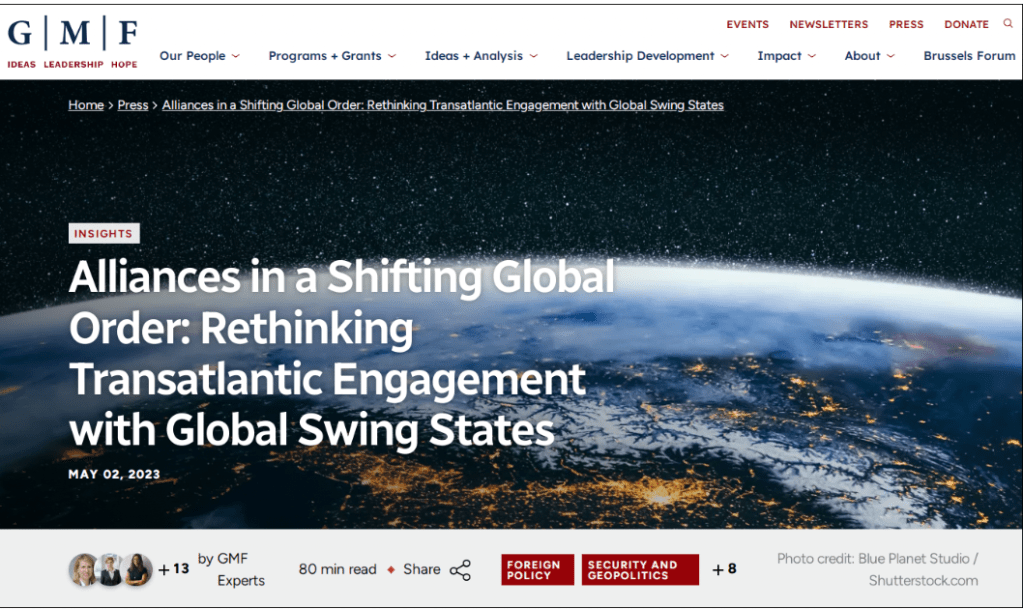
On May 2nd local time, the German Marshall Fund, a think tank based in Washington, D.C., released a new report stating that if Western countries such as the US and Europe want to maintain influence on the global stage, they must engage in more meaningful contact with a newly emerging group called “global swing states.”
The report cites Brazil, India, Indonesia, Saudi Arabia, South Africa, and Turkey as representative examples of so-called “global swing states.” These countries have significant international influence but have different preferences for cooperation outside the Western transatlantic alliance. Especially in the midst of the Russia-Ukraine conflict and increasing US-China competition, these countries have greater influence in global affairs than ever before.
“Flexibility is needed for international cooperation”
The report states that Brazil is pragmatic in its approach to partnerships, and its leadership does not see cooperation with different partners such as China, the EU, Russia, and the US as mutually exclusive.
Therefore, the West should engage in more cooperation in global government issues, including climate change and eliminating inequality, and accept the shift of “traditional centers of power.”
In addition, South Africa advocates for a multipolar global order and positions itself as a so-called “global southern country.”
Two of the authors of the report, Martin Quencez and Rachel Tausendfreund, believe that the governments of these “global swing states” do not see themselves as choosing between “two poles.”
“They prefer to carefully shift from one option to another periodically, issue by issue, according to their own particular interests and demands from strategic analysts,” the report says.
“Balancing between major powers”
Facing border issues and economic competition with China, India is moving closer to the West, but its strategic “non-alignment principle” also maintains good relations with countries like Russia. Therefore, the report suggests that the West should abandon a “with us or against us” mentality and engage in more targeted multilateral diplomacy with India to better connect with the country.
Regarding Indonesia, the report believes that its goal is to stay out of competition between major powers, and on the South China Sea issue, Indonesia also hopes to handle the issue without the involvement of the United States. Although the West continues to criticize the so-called “non-free policies,” Indonesia has not responded positively to these criticisms due to the West’s own colonialism and atrocities committed during the Cold War.
Quencez and Tausendfreund wrote, “A more constructive foreign policy discourse could be built around mutual respect for national sovereignty and multilateralism.” They believe that in fact, these “global swing states” do not see the US or Europe as reliable defenders of national sovereignty.
“Different defense and trade partners”
Turkey’s strategy is also to seek balance among major powers to mitigate the impact of their confrontation, as evidenced by its recent role as a mediator in the Russia-Ukraine conflict.
The report notes that Turkey remains an important member of NATO and a close economic partner of the EU, but in Turkey’s view, the world is not just the five permanent members of the UN Security Council.
Saudi Arabia also maintains close security relations with the West, but now Saudi Arabia is one of the main partners of Russia in the OPEC+ oil-producing countries alliance and a major trading partner of China. The report suggests that the West should not ignore the mediating role of other countries in the world, and the United States should reduce its focus on the Middle East.
Overall, the report believes that the US and Europe must demonstrate flexibility in international cooperation and maintain an open attitude towards assistance to non-Western countries, avoiding forcing geopolitical partners to make “with us or against us” choices.
In fact, as early as 2012, the German Marshall Fund, in partnership with another think tank, the New America Foundation, first proposed the concept of “global swing states” in a report titled “Global Swing States: Brazil, India, Indonesia, Turkey, and the Future of International Order,” which revealed the strategic assessments, strategic anxieties, and responses of some political forces in the US in the face of constantly changing international situations, especially the new situation of China’s continuous development and growth.
While this report suggests a strategy for the US or the West, it is also worth noting that China has pursued a similar approach. China has established strong or increasing relationships with countries such as Brazil, Indonesia, Saudi Arabia, South Africa, and Turkey, although its relations with India have been somewhat contentious.
 US-China Relations Updates
Leave a comment