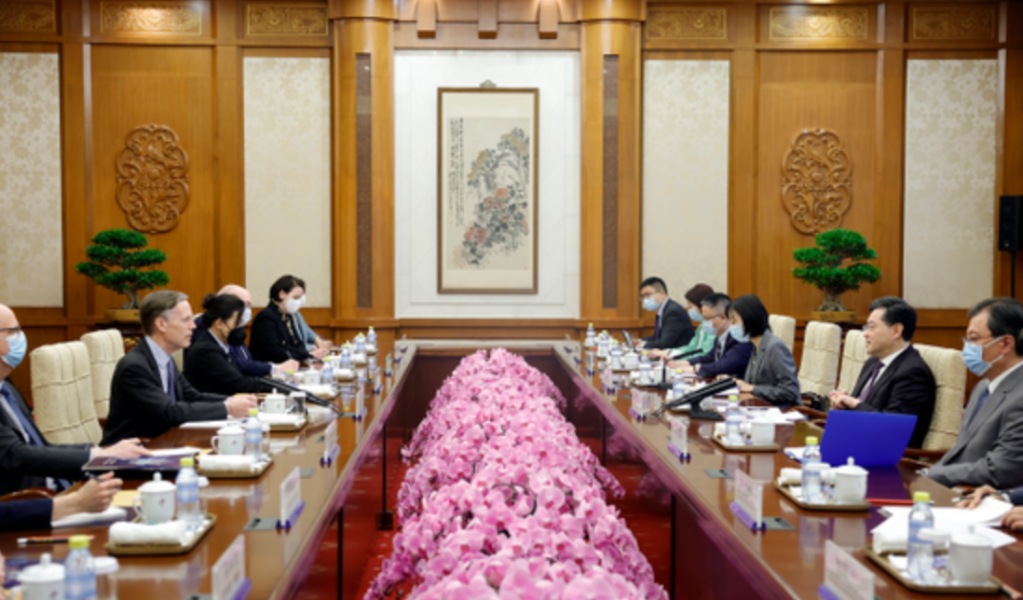
[May 8] I noticed that the international media paid considerable attention to this meeting, with Reuters in the UK and Bloomberg in the US publishing news reports as soon as possible. Normally, it is common for a foreign minister to meet with the ambassador of a host country, but given the weight of the China-US relationship as the most important bilateral relationship in the world and the current state of comprehensive tension between the two countries, Qin Gang’s statement today to Burns is like “encountering ice again”. Therefore, against this backdrop, this meeting has attracted the attention of the global media. Bloomberg’s headline today emphasized “China’s New Foreign Minister Meets US Envoy for First Time”, which means “China’s new foreign minister meets the US ambassador to China” but I have reservations about the use of the word “new” in the title. Given the intensity and density of all-around diplomacy among major powers today, emphasizing this “new” is inappropriate and out of place. Today, Qin Gang is also flying to Europe for visits to three countries, and as a foreign minister of a major power, he is truly working hard.
One contrasting background is that Qin Gang was promoted to foreign minister during his visit to the US. At the time of his return to China from the US, the Politico news website in the US published a long article stating that during Qin Gang’s tenure as ambassador to the US, Secretary of State Blinken did not meet with him. The US media believed that this constituted a major misjudgment by the White House foreign policy team.
Qin Gang spoke very frankly to Burns today and said many important things. The “ice” he referred to represents the high-level Chinese assessment of the current state of the China-US relationship. Therefore, Qin Gang called for the urgent need to stabilize the China-US relationship, avoid a spiral decline, and prevent accidents between China and the US. He referred to this as the consensus and bottom line of the China-US relationship. The reason for such emphasis is that the most important bilateral relationship in the world, which has encountered ice again, is still unstable and in a continuous downward spiral. Even unexpected events like the balloon incident have already occurred and continue to pose various challenges and risks to the China-US relationship. It should also be emphasized that these challenges and risks are not only faced by China and the US but also by the external world. In fact, foreign ministers of major powers have given extremely concise and powerful responses to this. When Qin Gang returned to China after his tenure as ambassador to the US, he wrote to The Washington Post, with a headline that left a deep impression on everyone: “A stable China-US relationship is crucial to the future and destiny of our planet”.
Based on the meeting announcement released on the Foreign Ministry’s website, Qin Gang’s speech was very comprehensive, thorough, and specific, covering various aspects such as China’s perception, relationship practice, bottom line, and emergency response. It can be regarded as a clear and powerful roadmap for breaking the ice in the most important bilateral relationship in the world.
Qin Gang reiterated that China’s bottom line and the red line must be respected, especially regarding the Taiwan issue. The principle of One China must be upheld and support for “Taiwan independence” separatist forces must be stopped. During the Bali meeting between the Chinese and US leaders, China emphasized that the Taiwan issue is the core of China’s national interests, the foundation of the political foundation of China-US relations, and an unshakable red line. Qin Gang also pointed out that communication cannot be one-sided while the other side continues suppressing and containing China. The US cannot say one thing and do another. To a large extent, the US saying one thing and doing another, typical of someone who wants to communicate while suppressing and containing China, is the root cause of the continued pressure on China-US relations and a source of pain points. For example, recently, senior US officials from Secretary of State Blinken and Treasury Secretary Yellen to Climate Envoy Kerry have all emphasized their willingness to visit China. After meeting with Qin Gang today, Burns tweeted that “we discussed the challenges in the US-China relationship and the necessity of stabilizing the relationship and expanding high-level communication.”
Therefore, Bloomberg’s report today emphasized in the introduction that this is the highest-level meeting between the world’s two largest economies in several weeks, indicating that after rejecting the Biden administration’s requests for communication, Beijing may agree to more high-level dialogue between China and the US. However, if the US cannot face the pain points of China-US relations, especially on the issue of bottom lines and red lines that cannot be crossed, and does not correct its two-faced behavior of saying one thing and doing another, it will be difficult for China and the US to achieve or even maintain high-level communication and dialogue, and it will be equally difficult to break the ice in the relationship. From the current situation, the pressure on China-US relations to break the ice is enormous, and the US is still “making ice”. The upcoming G7 summit in Japan later this month is undoubtedly a window of observation. US media are already hyping up Biden’s plan to bring more allied partners to contain China with so-called AI technology during the summit. What is more worrisome is whether the US will continue to push and encourage G7 member states to hype and even interfere in the Taiwan Strait agenda.
 US-China Relations Updates
Leave a comment