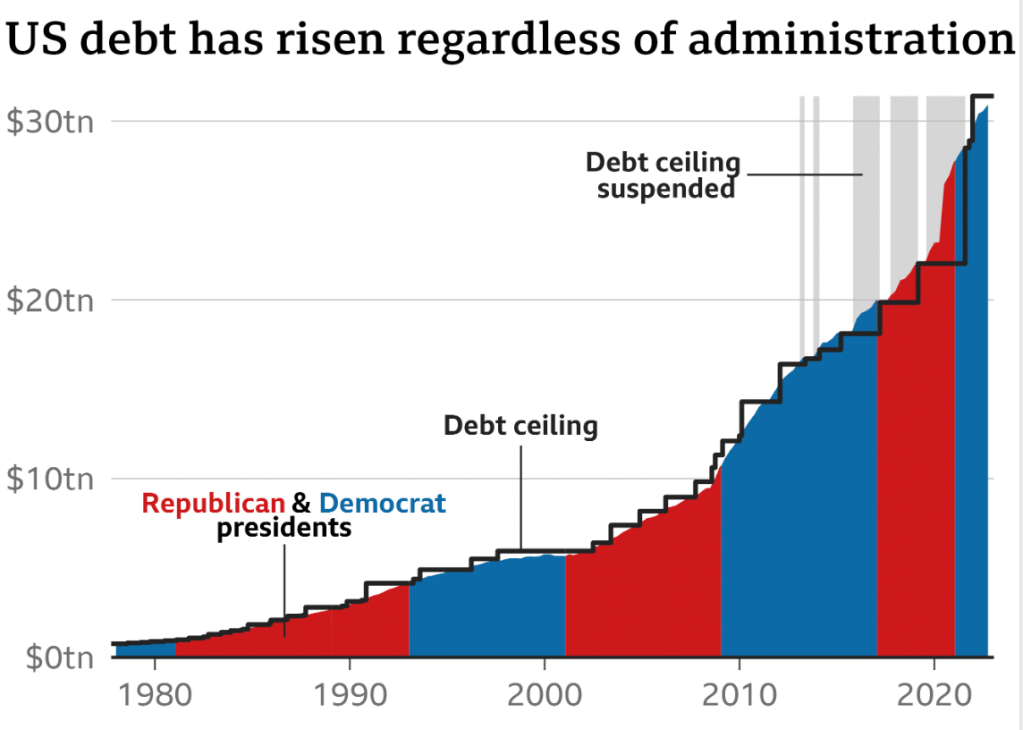
US Treasury Secretary Janet Yellen has warned that the federal government may run out of money to pay its debts on June 1, but some Republican lawmakers, whether serious or bluffing, seem prepared to let the US default on its debt or come dangerously close to it.
The current debate centers on whether President Biden can bypass the debt limit fight by invoking the 14th Amendment to the Constitution, which states that the validity of US public debt “shall not be questioned,” and the so-called “post-enactment rule” (which holds that the latest congressional budget law supersedes any law that gives the debt limit effect).
Cornell University law professor Robert Hockett wrote in the New York Times that President Biden has strong legal reasons and arguments to invoke the 14th Amendment to the Constitution to avoid a potentially catastrophic outcome of the United States defaulting on its debt. The possible consequences of allowing the US to default on its debt include:
First, losing the “unquestioned” sovereign credit rating. This would cause upheaval in the US banking industry, financial markets, and even global capital markets. The US public debt market is currently the world’s largest asset market, with a size of $24 trillion. US Treasury bonds are also the primary safe asset in the investment portfolios of banks, retirement funds, mutual funds, and other companies. Once the US debt credit collapses, the resulting financial crisis will make the recent storm of regional bank failures, such as Silicon Valley Bank (SVB), look like a small event.
Second, if the US defaults on its debt, the value of the US dollar as a global reserve go global reserve currency will sharply depreciate worldwide. Since the US ceded its position as a major exporter to China, the value of the US dollar relative to other currencies is mainly due to the global demand for US dollar assets. Since the US Treasury issues a huge amount of bonds, a sharp drop in US bonds will inevitably drag down the value of the US dollar. This will quickly push up the prices of imported goods, making US inflation skyrocket, more like contemporary Argentina or Russia 20 years ago, far more severe than now or in the 1970s.
Third, the US will be unable to maintain overseas military bases and other overseas assets, and will not have the money to pay salaries to US military personnel. This will only help Beijing, along with Russia, Brazil, and other countries, to replace the US dollar with the renminbi and enhance China’s momentum to become a global superpower.
Fourth, even if the US default on its debt is only a major risk that has not yet occurred, it will quickly push up the cost of debt service and make the US deficit problem worse than it is now. If that were to happen, it would only highlight the contradiction between Republican claims that they are “trying to tie spending cuts to the debt limit bill,” and expose that what House Speaker Kevin McCarthy and his gang really want is not fiscal accountability.
Hockett expects that if Biden decides to challenge or ignore the debt limit and instructs Yellen to continue to pay federal debt around June 1, the best-case scenario would be for McCarthy and his gang to realize that they don’t have a legal leg to stand on, abandon the continuing farce, and pass a budget bill that can be accepted by the Senate and Biden.
He pointed out that, other than that, McCarthy has only one other option: sue Biden and seek to stop his decision to have the US fulfill its debt obligations (which have long been established by law). Imagine arguing in court for “allowing the US to default on its debt,” what is the likelihood of winning the approval of the Supreme Cour justices (even if right-wing justices may have the upper hand)? Moreover, for McCarthy and other Republicans, doing so would entail enormous political risks.
 US-China Relations Updates
Leave a comment