The Canadian government announced on Monday (8th) the expulsion of Chinese Consulate official Zhao Weidong, who is suspected of involvement in the harassment of the family of Canadian MP Michael Chong in Hong Kong. In response, China demanded that the Canadian Consul General in Shanghai leave China within 5 days. Canadian Prime Minister Justin Trudeau responded strongly, stating that they will not accept foreign interference and will not be intimidated by China’s future actions. Scholars pointed out that this is the first diplomatic expulsion between China and Canada since the establishment of diplomatic relations, and although it is a major blow to the relationship, it is not expected to affect the basic relationship between the two countries.
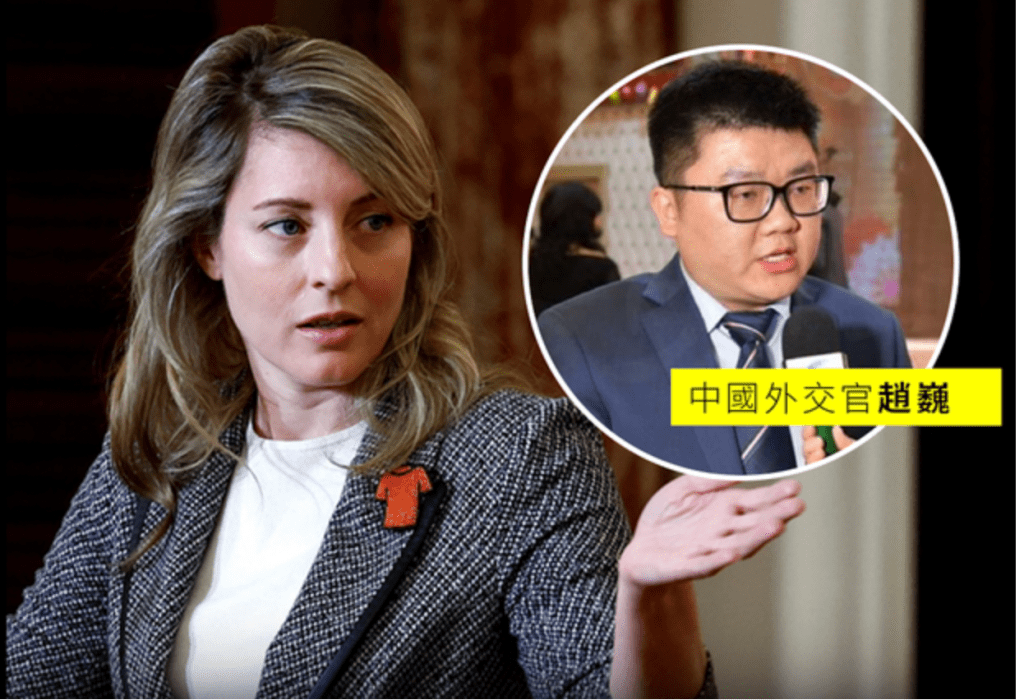
Regarding Zhao Weidong, the head of the Political Section of the Chinese Consulate General in Toronto who is suspected of participating in the threat against MP Michael Chong and his family, the Canadian government announced on Monday (8th) the expulsion of Zhao, accusing him of “long-term interference in Canadian internal affairs” and “harassing the family of a Canadian MP.” Canadian Foreign Minister Melanie Joly stated that after careful consideration of all factors, they decided to designate Zhao Weidong as “persona non grata” and warned other foreign diplomats in Canada that they would also be expelled if they engage in interference activities.
China immediately took “corresponding countermeasures” and announced on Tuesday (9th) afternoon that Jennifer Lalonde, the Consul General of the Candian Consulate General in Shanghai, would be designated as “persona non grata” and required to leave China by Saturday (13th). China reserves the right to take further action.
Chinese Foreign Ministry spokesperson Wang Wenbin said, “The Canadian side ignored China’s solemn representations and declared a Chinese diplomat as ‘persona non grata’ on the pretext of the lie of ‘interfering in Canadian internal affairs’.” The spokesperson for the Chinese Embassy in Canada criticized the Canadian government for seriously violating relevant bilateral agreement and deliberately undermining China-Canada relations.
Regarding China’s retaliation, Canadian Prime Minister Justin Trudeau told reporters in Ottawa that they anticipated retaliatory actions, but they will continue to take all necessary measures to ensure that Canadians are not subject to foreign interference. Trudeau stated that they must take responsible action to send a clear message, and Canada will not be intimidated regardless of China’s future actions.
Canadian Conservative MP Michael Chong criticized the Canadian government for not taking action to expel Chinese diplomats who have engaged in such behavior for many years.
Diplomatic expulsions are not common in Canada. The last time was in 2018, when Canada and its Western allies expelled Russian diplomats due to allegations of the Kremlin’s involvement in the poisoning of former Russian spy Sergei Skripal and his daughter Yulia with a nerve agent. Scholars emphasized that Canada will never accept China’s bullying behavior and actions.
This is the most severe test of the Canada-China relationship since the Huawei “Meng Wanzhou incident”. Professor Cheng Yu-sho, a retired political science professor at City University of HK, stated in an interview with our station that the mutual expulsion of diplomats between Canada and China is a first since the establishment of diplomatic relations between the two countries.
Cheng believes that Western countries’ civil society and opposition parties will never accept China’s bullying behavior, especially when the Canadian opposition party criticizes the ruling party for being weak on China.
However, Cheng does not think that this confrontation will affect the “basic relationship” between Canada and China, especially in trade, investment, and tourism. Cheng interprets that the reason China expelled the Canadian Consul Gener in Shanghai instead of the ambassador in Beijing is that the diplomatic action is “reciprocal”, and Canada’s target is not embassy personnel.
Cheng said: “I believe everyone will be careful and limit the impact of the incident. The impact is mainly on the image, especially the image of China, which has been somewhat damaged in Canadian civil society. But I believe the Canadian government does not want to affect the important economic and trade exchanges between Canada and China.”
Scholars predict that the Canada-China relationship will enter a freezing period
Assistant Professor Lai Wing-wai of the General Education Center at Longhua University of Technology told our station on Tuesday that Canada-China relations have been bad in recent years, and mainstream Canadian society is anti-China or distrustful of China. Trudeau, who was seen as more pro-China, has been seeking to improve and promote relations with China, but this has gradually changed in recent years. China’s intervention in Canadian domestic affairs this time has naturally caused a commotion in society, and the Canadian government will certainly have to respond. He believes that the relationship between the two countries will further cool down in the short term.
Lai said: “China is just repaying in kind. I think the relationship will deteriorate in the short term. Eventually, they will seek to manage and control, just like Biden. But management and control do not mean that the relationship between the two countries will improve rapidly. I think we should take it step by step, and you release a step of goodwill, then I release a step of goodwill. Looking at the relationship between the two countries in the past few years, they have basically laid the foundation for conflict, so it is easy to trigger. Now the relationship between the two countries is not very stable.”
The deterioration of Canada-China relations did not happen overnight. After the arrest of Huawei’s CFO Meng Wanzhou in Canada in 2018, China subsequently detained former Canadian diplomat Michael Kovrig and businessman Michael Spavor, officially accusing them of engaging in espionage activities. This worsened the tense relationship between the two countries and was dubbed “hostage diplomacy”. Two years ago, Canada released Meng Wanzhou, and China also released Kovrig and Spavor.
In recent months, allegations of Chinese interference in Canadian elections have also shocked Canada. Several media outlets, including The Globe and Mail, have revealed leaked intelligence reports accusing the Chinese government and its diplomats in Canada of trying to manipulate the past two elections to ensure victory for Prime Minister Trudeau’s Liberal Party. At that time, Foreign Minister Chystia Freeland stated that “we will not accept any violation of the Vienna Convention by Chinese diplomats on Canadian soil.”
It is reported that on Tuesday, the Canadian House of Commons passed a motion that includes: establishing a foreign agent registration system; launching a public investigation into foreign interference in Canadian elections; closing Chinese police stations in Canada; and expelling all Chinese diplomats involved in infiltration activities.
Earlier, Michael Chong accused the Chinese authorities of harassing his family in Hong Kong, with an alleged attempt to intimidate. The incident caused a considerable reaction in the Canadian political sphere, with direct accusations of the government’s weak stance towards China. Afterward, Canadian media reported that Zhao Wei was involved in this incident.
In February 2021, Michael Chong initiated a motion accusing China of “genocide” against ethnic minorities such as the Uighurs, which was passed overwhelmingly by the Canadian House of Commons. In March of the same year, after Canada, the UK, and the US sanctioned China over the Xinjiang issue, China’s Foreign Ministry announced countermeasures, listing Michael Chong as a target of sanctions. According to the Chinese sanctions, Michael Chong is prohibited from entering mainland China, Hong Kong, and Macau, and Chinese citizens and institutions are prohibited from conducting business transactions or exchanges with him.
According to recent reports from Canadian media, Zhao Wei, the expelled Chinese diplomat , worked at the Consulate General in Toronto and was responsible for overseas Chinese affairs. He has organized activities supporting the Chinese government among overseas Chinese, including mobilizing them to demand “the release of Meng Wanzhou.”
According to information, Cong Yi-hui is a political, economic, and public affairs consul at the Canadian Consulate General in Shanghai. She has served as a development counselor at the Canadian High Commission in Sri Lanka and the Deputy Director of the Afghanistan Office of the Canadian Global Affairs Department, as well as the Deputy Director of the Strategic Policy and Performance Office and the Project Manager of the Bolivia, Brazil, and Caribbean Region Programs.
 US-China Relations Updates
Leave a comment