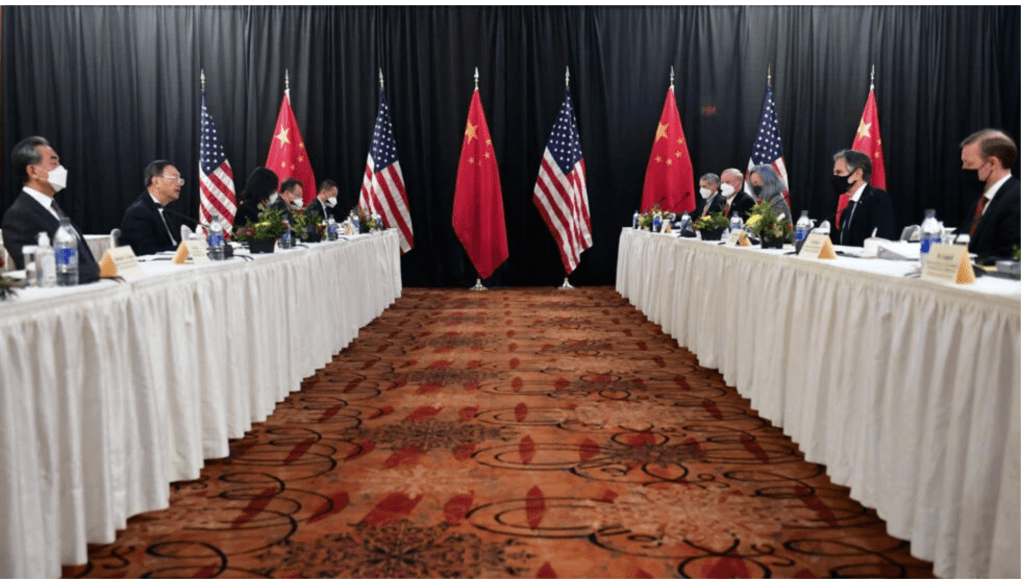
[May 12] Since the US shot down a Chinese balloon and Secretary of State Blinken “postponed” his trip to China at the last minute, high-level contacts between China and the US have been almost cut off. On Thursday, US National Security Advisor Sullivan and Chinese Foreign Minister Wang Yi met in Vienna, raising questions about whether Biden and Xi Jinping will resume dialogue.
Recently, the White House has frequently signaled that Biden wants to engage in dialogue with Xi Jinping, but Beijing’s response has been lukewarm. Chinese state media has portrayed the domestic signals to the US as a tough stance, even going so far as to describe the meeting between Wang Yi and Sullivan as a “cold confrontation”.
Comments under Xinhua’s related reports included: “What trap is the American imperialist trying to set for us now?” “Both Blinken and Sullivan are anti-China hawks, we should not be polite with them!” “Will China give up on Taiwan? Absolutely not! Does the US want China to have an easy time? Also absolutely not. Give up your fantasies. Friendly cooperation is absolutely impossible!” and “The American imperialist wants to be a whore and stand on a pedestal at the same time!”
The incident in February where a Chinese spy balloon entered US territory worsened the already tense US-China relations. The US administration ordered the balloon to be shot down under strong pressure from Congress, while China denied that the balloon had any reconnaissance mission. The US canceled Secretary of State Blinken’s planned trip to Beijing in November, which had been agreed upon during the Biden-Xi summit.
However, regardless of how “patriotic” netizens may not understand Beijing’s abandonment of its tough stance, the meeting between Wang Yi and Sullivan indicates that the US and China are beginning to ease tensions. It is not surprising that netizens are still in an angry mood created by the official narrative, as relations between the two countries have plummeted since the US shot down the Chinese balloon.
What Sullivan and Wang Yi talked about was kept brief by both sides. The US side said they had a “frank, substantive, and constructive discussion”, while Xinhua reported that they had “a frank, in-depth, substantive, and constructive discussion on removing obstacles and stabilizing Sino-US relations.”
According to the White House, the discussion ranged from the “Russian invasion of Ukraine” to the Taiwan issue. Obviously, the most sensitive issues for both countries were discussed. The former is of most concern to the US, while the latter is something Beijing never forgets. Chinese state media took its usual tone, saying “Wang Yi fully explained China’s stern position on the Taiwan issue.” China and the US also exchanged views on “international and regional issues of common concern such as Ukraine.” Both sides agreed to continue using this strategic communication channel.
Rumors of a Biden-Xi summit soon to take place have been circulating since the Sullivan-Wang Yi meeting. When asked by reporters on Wednesday, Biden said he was “arranging” a call with Xi Jinping and that there was “progress”. Their last meeting can be traced back to the G20 summit in Indonesia in November 2022.
According to the Chinese Ministry of Foreign Affairs website, when asked by a Bloomberg journalist about “how China views US efforts to strengthen contacts,” Chinese Foreign Ministry spokesperson Wang Wenbin said that “the US cannot talk about communication on the one hand and continuously suppress and contain China on the other. They cannot say one thing and do another.” Wang Wenbin reiterated that the US needs to “respect China’s bottom line and core interests.”
China’s “core interests” mainly concern the Taiwan issue, but this is also a “rising tide lifts all boats” issue. The more pressure Beijing puts on Taiwan, the more Taiwan pushes back, especially with the support of the West, particularly Western parliaments. The Tsai Ing-wen government refuses to accept the “1992 Consensus,” while Beijing’s military aircraft continue to harass Taiwan, resulting in unprecedented tensions between the two sides.
Biden has always emphasized that he will not make any concessions to China in the competition between the two superpowers, but what he wants to do is to ensure that the competition between the two countries does not escalate into conflict. In Biden’s view, the goal is to establish a “fence” to avoid conflict through regular high-level dialogue between the two sides.
The US also hopes to cooperate with China in areas where cooperation is possible, such as climate change, health and economic regulation. To this end, a senior delegation led by Treasury Secretary Yellen is expected to visit China, but it has not been confirmed yet.
Sullivan gave a widely commented speech on April 27, outlining US strategy in terms of economic sovereignty and industrial amibisions , with a special focus on Beijing. Sullivan used the wording of European Commission President von der Leyen, saying that the US is not seeking to “decouple” from China, but rather to “reduce risk.”
The highest foreign policy and security advisor to Biden said that the US and China need to manage their competition responsibly. “Even when we compete, we need to maintain channels of communication,” he said. He acknowledged that “a certain level of strategic maturity” is required to recognize this problem.
Therefore, the result of the meeting between Sullivan and Wang Yi is that both sides agreed to maintain Strategic communication channels, which should reflect this “certain level of strategic maturity”.
However, from Wang Wenbin’s statement, it seems that he tends to attribute the US’s “strategic maturity” to the fact that they “say one thing and do another”. This statement seems to have injected a sense of “The American imperialist wants to be a whore and stand on a pedestal at the same time” into some of the official media and its followers.
Why Sullivan, not Blinken? because Blinken is somewhere designing American’s new grand strategy for Africa and Middle East.. and Sullivan’s recent speech about US Strategy.
 US-China Relations Updates
Leave a comment