The China-Central Asia Summit is scheduled to be held in Xi’an from May 18th to 19th. According to the Chinese Ministry of Foreign Affairs, this summit is the first major foreign affairs event hosted by China this year, and it is also the first time that the heads of state of the six countries have held a summit in person since the establishment of diplomatic relations between China and the five Central Asian countries 31 years ago.
Several analysts told the Global Times on May 17th that against the backdrop of Washington’s increasing pressure on China and the complex and ever-changing international and regional situation, the importance of the Central Asian region in China’s foreign relations agenda is on the rise, and the relationship between the two sides is expected to be further strengthened. At this summit, it is expected that achievements will be made in areas such as connectivity and industrial chain cooperation. Regarding the issue of Ukraine, analysts predict that it will not be the “most important issue” at this summit. However, Central Asian countries generally support China’s position on the Ukrainian issue , and it is expected that a joint statement will be issued on this issue after the summit.
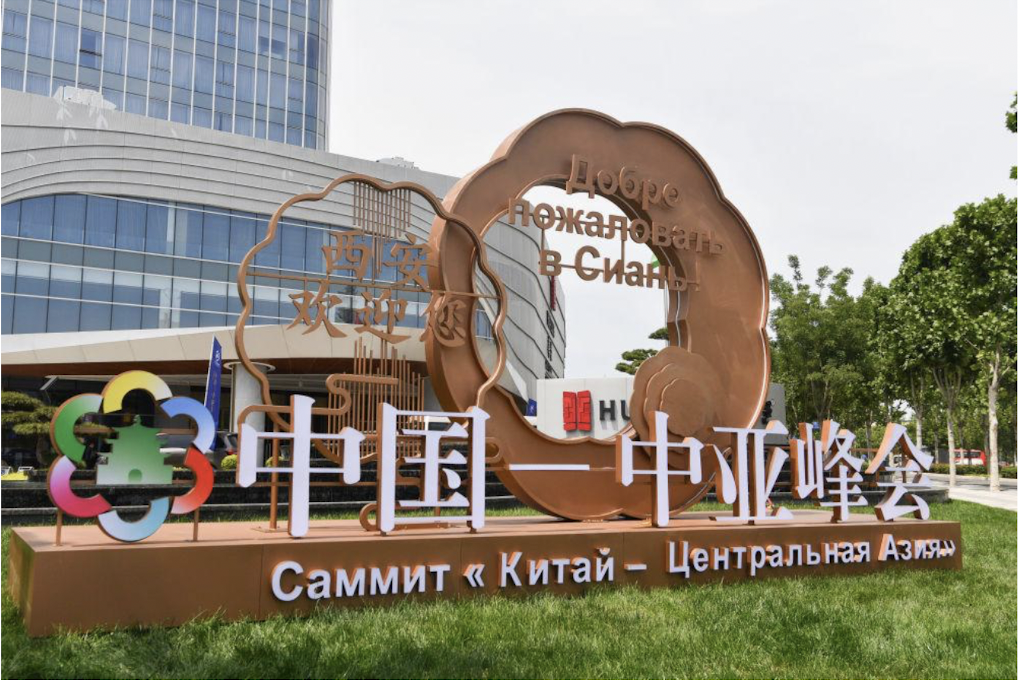
The China-Central Asia Summit logo
The China-Central Asia Summit and the G7 Hiroshima Summit: a sharp contrast between simultaneous meetings
Zhao Huirong, a researcher at the Institute of Russian, Eastern European and Central Asian Studies of the Chinese Academy of Social Sciences, told the Global Times on May 17th that the first China-Central Asia Summit is being held now mainly because of the needs of China’s constantly developing relations with the Central Asian region. It is a “natural fit” and believes that this summit mechanism will become a normalized and institutionalized cooperation and promote China’s relations with the five Central Asian countries to a higher level.
It is worth noting that the China-Central Asia Summit is being held at the same time as the G7 Summit in Hiroshima, Japan on May 19th. Foreign media generally expect that the G7 countries are more likely to take a unified stance “against China and Russia” at the summit. The coincidence of the timing of the two summits has attracted public attention.
“I don’t think the China-Central Asia Summit intentionally coincides with the G7 in terms of specific timing, because high-level summits require a long advance preparation time,” said Wang Xiaoquan, a researcher at the Institute of Russian, Eastern European and Central Asian Studies of the Chinese Academy of Social Sciences, in an interview with the Global Times. However, the fact that the two summits are almost simultaneous does send a “significant signal” to the world.
The Eastern Europe and Central Asia affairs expert believes that the G7 Summit is expected to mainly discuss how to maintain its dominance in the world order and monopolistic economic status, while China and Central Asian countries, as developing countries, are seeking to establish a more just and reasonable world order. They are expected to jointly explore China’s global security initiative, global development initiative, and Belt and Road Initiative. It is believed that the topics of this summit will represent the trend of world and era development.
“The ‘China + Central Asia Five’ cooperation mechanism is a new model for China’s cooperation with Central Asian countries. In 2020, China and the five Central Asian countries established a regular foreign ministers’ meeting mechanism. In June 2022, the ‘China-Central Asia Five’ heads of state meeting mechanism was established, and the first summit will be hosted by China.
“Deutsche Welle” quoted relevant experts as saying that the cooperation mechanism between China and Central Asia is a new model that increases the level of exchanges between the two sides. Beijing is seeking to establish a “regional unity” in Central Asia, and “due to Russia’s sanctions, the role of Central Asia in international affairs is more prominent… under the Belt and Road Initiative, Central Asia is seen as a transit station for trade and circulation between China and Europe.”
As the great power game intensifies, “the importance of Central Asia in China’s foreign relations agenda is on the rise.”
“Faced with the uncertainty of the Ukraine conflict and the growing hostility of the West (towards China), China is expected to further strengthen its relations with Central Asia.” The South China Morning Post analyzed on May 17th that for a long time, Beijing has regarded Central Asian countries as key partners for trade cooperation, energy security, and maintaining stability in the northwest border region, and has sought closer ties with Central Asia. “In September 2022, Chinese leaders made their first state visit after the outbreak of the COVID-19 pandemic to Kazakhstan, which surprised many people.” In contrast, the US president has never set foot in Central Asia.
However, the US has also sought to strengthen its presence in Central Asia in recent years. In February of this year, US Secretary of State Blinken visited Kazakhstan, the highest-ranking official of the Biden administration to visit Central Asia. The New York Times and other media outlets believe that Central Asian countries have strong ties with Moscow and are unlikely to shift away from it, and the US is well aware of this, but its move is aimed at “competing with China and Russia for influence.”
Wang Xiaoquan told Global Times reporters that Central Asia has unique strategic significance for China, which is even more highlighted under the current international and regional situation. “Central Asia is China’s strategic rear in response to security challenges from the eastern maritime direction,” he explained. With the intensification of the strategic competition between China and the United States, and the United States’ efforts to build an alliance system around China’s coastal areas, China needs Central Asia to maintain stability. Changes in the security situation in Central Asia, as China’s neighbor, will have an important impact on the security of China’s northwest border.
He emphasized that Central Asia is an important energy supply base for China, with the Central Asia oil pipeline and the Central Asia natural gas pipelines A, B, and C having annual oil and gas transportation capacities of 20 million tons and 55 billion cubic meters respectively. In 2022, China imported 11.262 million tons of oil and 43.21 billion cubic meters of natural gas through the Central Asia pipeline. “Central Asia is crucial for China’s energy and strategic security,” he said.
Public information shows that the mineral resources in Central Asia are abundant, making it a strategic energy and resource base for the 21st century. Kazakhstan is the largest oil-producing country in Central Asia, and Turkmenistan is known as the “country standing on a gas bag,” with the fourth largest proven natural gas reserves in the world, with the highest annual production reaching 63 billion cubic meters. Sixty-three percent of Uzbekistan‘s territory is located in oil and gas condensation zones, making it one of the world’s 15 largest natural gas producing countries. China, as the world’s largest energy consumer and a major oil and gas importer, needs to ensure its national energy supply security.
Against this backdrop, the China-Kazakhstan oil pipeline became China’s first cross-border crude oil pipeline for land imports. The pipeline, with a total length of 2,835 kilometers, officially started construction in September 2004 and began operations in 2006. In addition, there is also a natural gas pipeline between China and Central Asia. Pipeline A and B run from the border of Turkmenistan and Uzbekistan, passing through the central part of Uzbekistan and the southern part of Kazakhstan, and entering China through the Horgos port in Xinjiang. The pipeline is 1,833 kilometers long and was put into operation in 2009. Pipeline C runs parallel to pipelines A and B and was completed and put into operation at the end of May 2014.
“The importance of Central Asia in China’s foreign relations agenda is on the rise,” said Zhao Huirong to Global Times reporters. China has established strategic partnerships with all five Central Asian countries, and China and Kazakhstan have established a permanent comprehensive strategic partnership, which is unique,” she said.
She said that from a macro perspective, since the outbreak of the conflict in Ukraine, geopolitical thinking has been on the rise in the international community, and the trend toward polarization has become more pronounced, with voices of confrontation abound. For China and the five Central Asian countries to cooperate more closely, it can promote regional peace and development, send out a voice different from advocating confrontation between camps, and help avoid the world heading toward greater conflict.
Looking ahead, the two sides can establish a new land-based economic system that connects Asia and Europe. According to the Chinese Ministry of Foreign Affairs on the 16th, the leaders of the countries will deepen China-Central Asia strategic mutual trust and reach a series of important consensus on key areas of cooperation, and the six heads of state will jointly sign or witness the signing of many important political documents involving trade, investment, connectivity, and other fields.
According to AFP and Deutsche Welle, China is expected to launch new visa-free measures with the five Central Asian countries after the summit. Currently, Kazakhstan and Uzbekistan have reached an agreement with China on visa-free policies, while Kyrgyzstan is still negotiating terms with Beijing. In addition, the summit may continue to promote the level of interconnection between China and the five Central Asian countries, including the expansion of natural gas pipelines.
Zhu Yongbiao, executive director of the Belt and Road Initiative Research Center at Lanzhou University, told Global Times reporters that this summit will elevate China’s cooperation with the five Central Asian countries to a new height, especially in terms of industrial docking under the Belt and Road framework. In recent years, China’s cooperation with the five Central Asian countries has shifted from simple natural resource trade to industrial cooperation, and the summit is expected to deepen the industrial docking between the two sides.
As the China-Central Asia summit approaches, some foreign media have hyped up the idea of “competition between China and Russia in Central Asia,” “China filling Russia’s position in Central Asia,” and “Russia’s declining relationship with Central Asia.” Analysts, however, told Global Times reporters that these are tricks used by Western media to sow discord between China, Russia, and Central Asian countries.
Wang Xiaoquan explained to Global Times reporters that since the outbreak of the conflict in Ukraine, the US and the West have attached greater importance to Central Asian countries, and have increased efforts to sow discord between Central Asian countries and Russia. Under US influence, some elites in Central Asian countries advocate distancing themselves from Russia out of concern for their own sovereignty and security. However, it should be noted that Russia still holds a pivotal position in the political, economic, and security spheres in Central Asia.
“Russia has a collective security treaty organization and the Eurasian Economic Union with Central Asian countries, and there is a large population of Russian-speaking or ethnically Russian people in the region. In addition, the remittances from Central Asian laborers working in Russia are still one of the major sources of foreign exchange for some Central Asian countries,” he said. These factors make it clear that Russia will not be absent from Central Asia and will continue to exert significant influence in the region’s political, economic, and security affairs.
Global Times reporters noted that on May 9th of this year, the leaders of all five Central Asian countries went to Russia to attend the military parade on Red Square to celebrate the 76th anniversary of Victory in the Great Patriotic War. Some media analysts believe that Central Asian countries are very cautious in dealing with competition between superpowers such as China, Russia, and the US.
Zhao Huirong said that Western voices have always tried to incite discord between China and Central Asian countries, and between China and Russia. However, in reality, relations between China and Russia, and between China and Central Asian countries, are steadily developing at both bilateral and multilateral levels. Russia holds a positive attitude towards cooperation between China and Central Asian countries, and increasingly values China’s positive role in promoting stability and prosperity in the region.
“Cooperation between China, Russia, and Central Asian countries is a mutually beneficial process, not dominated by any one country. This cooperation is based on considerations of their own interests and focused on long-term development. For Central Asian countries, they adhere to a policy of comprehensive and diversified diplomacy, hoping to develop close cooperation with China while maintaining friendly relations with Russia, and there is no contradiction between the two,” she said.
Several experts told Global Times reporters that the Ukraine issue will not be the “main topic” of this summit. However, on this issue, Central Asian countries generally support China’s position and hope for a political solution to the crisis in Ukraine. They also hope that China can play a greater role in persuading and promoting talks. After the summit, it is expected that a joint statement will be issued by all parties to voice their opinions on regional hotspots.
 US-China Relations Updates
Leave a comment