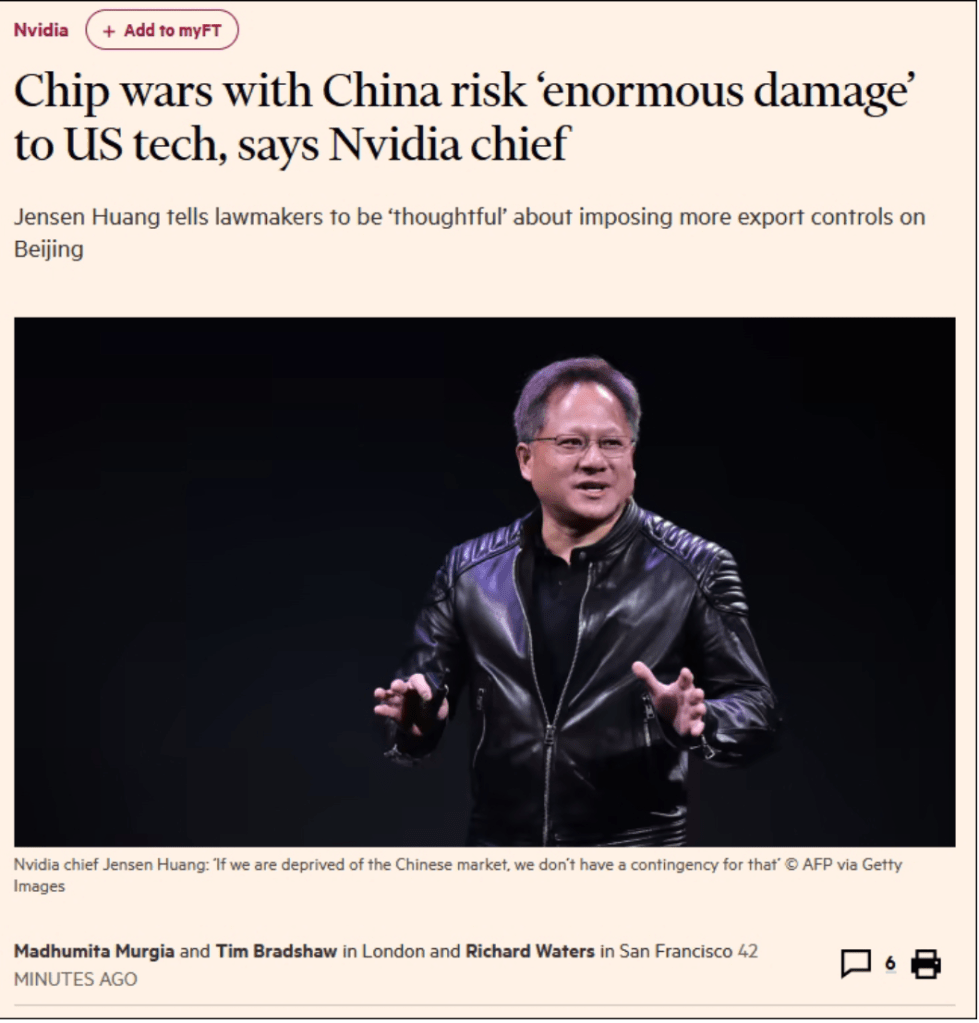
According to a report in the Financial Times on the 24th, Nvidia’s founder and CEO, Huang Renxun, warned that the US-initiated chip war is severely constraining domestic semiconductor companies and may cause “huge damage” to the country’s technology industry.
The report stated that during a recent interview, Huang Renxun stated that a series of semiconductor export control measures against China implemented by the Biden administration is tying the hands of the American chip manufacturing giant, preventing it from selling advanced process chips to China, one of its largest markets.
Huang Renxun also said that Chinese companies are beginning to develop their own chips, competing with Nvidia in areas such as gaming, graphics, and artificial intelligence. “If they cannot buy from the US, they will make their own. The US must be careful, China is a very important technology industry market.”
Huang Renxun pointed out that China accounts for about one-third of the US technology industry market, and its position as a source of semiconductor components and a product end market makes it irreplaceable. He warned US officials that they must “think carefully” when implementing further restrictions on China.
“If we are deprived of the Chinese market, we have no contingency plans. There is no other China in the world, only one China.” He said that the Chinese market is irreplaceable, and if trade cannot be conducted with it, it will cause “huge damage” to American companies.
In Huang Renxun’s view, the US semiconductor export restrictions to China may actually lead to the failure of the “Chip Act,” a Biden administration initiative aimed at supporting the US chip industry, because once the Chinese market is lost, the production capacity needed by the US technology industry will also decrease, and there will be no need for US factories, resulting in an excess of domestic factories.
The report stated that the current US efforts to prevent China from purchasing or developing advanced process chips have become the tensest front in the “new Cold War” initiated by the US. Just last weekend, the Cybersecurity Review Office announced that US chip giant Micron’s products sold in China did not pass cybersecurity reviews, and according to laws and regulations such as the Cybersecurity Law, operators of critical information infrastructure in China should stop purchasing Micron’s products.
Prior to this, industry insiders and media had issued similar warnings to Huang Renxun. The Wall Street Journal on May 7th reported that in the development boom of generative AI, US semiconductor export controls to China are driving many leading Chinese technology companies to accelerate their research and development, seeking to use domestically developed chip resources to develop cutting-edge AI and break free from reliance on individual foreign advanced process chips. The report also cited evaluations of research papers and interviews with relevant employees, stating that although this poses a certain challenge, some experiments have already shown prospects for breakthroughs in circumventing US blockades, and Chinese technology companies may be even better equipped to adapt to potential future restrictions.
Not only inchip design, ASML’s CEO Peter Wennink pointed out in January that US-led semiconductor export controls against China may also prompt China to develop its own technology in the high-end chip manufacturing equipment field. “The more pressure you put on them, the more likely they are to redouble their efforts,” Wennink said, adding that if Chinese semiconductor companies cannot obtain such machines, they will develop their own and manufacture lithography equipment that can compete with ASML. He further stated at the annual shareholder meeting in April that in the face of US pressure, China is seeking to develop its own semiconductor manufacturing equipment, which is “reasonable and logical.”
“China is the world’s largest semiconductor market. Forcing ‘decoupling and disconnection’ with China and interfering with the market behavior does not serve the interests of either side,” Chinese Foreign Ministry spokesperson Mao Ning said at a routine press conference on May 4th. For some time, the US has generalized the concept of national security and abused export control measures to restrict exports to China in order to maintain its own hegemony. US actions not only suppress China, but also deprive developing countries of their right to technological progress and normal development, and permanently keep these countries suppressed at the low end of the industrial chain. This selfish and self-interested technological bullying is unfair, non-compliant, and disrupts the stability of global industrial and supply chains, which is not conducive to the development of the world economy and will ultimately backfire on itself. China remains is committed to high-level opening up to the outside world and is willing to work with all countries to develop and share opportunities. We will also firmly defend our legitimate rights and interests. Restraining and suppressing China’s development will not work, but will only enhance China’s determination and ability to achieve technological self-reliance and self-improvement.
 US-China Relations Updates
Leave a comment