Introduction
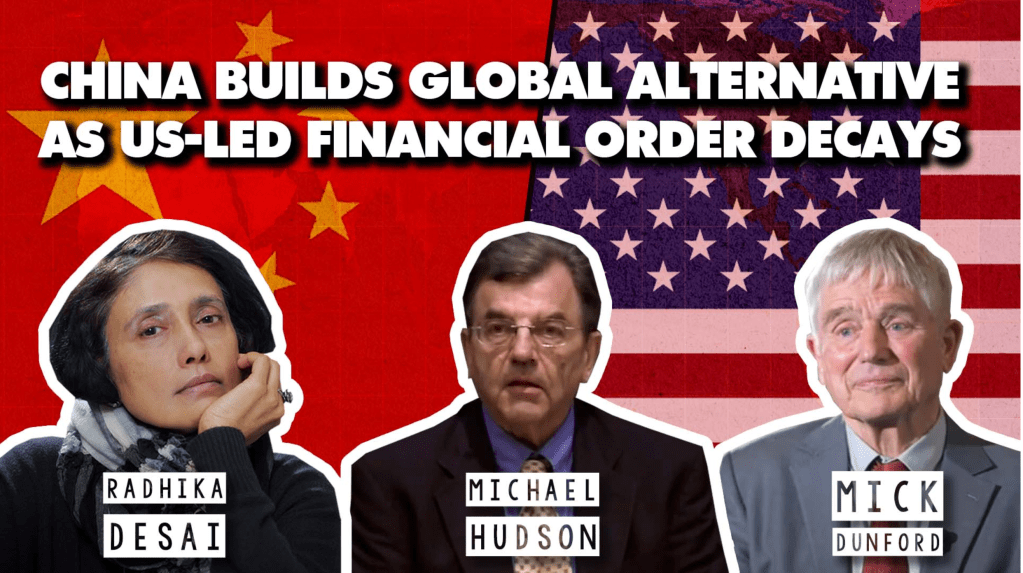
Political economists Radhika Desai and Michael Hudson join economic geographer Mick Dunford to analyze and discuss China’s efforts to create a global alternative to the US-led neoliberal financial order, which appears to be decaying. The authors explore China’s economic policies, strategies, and initiatives, focusing on the Belt and Road Initiative (BRI) and the Asian Infrastructure Investment Bank (AIIB).
China’s Economic Growth and the Shift in Global Power
China has experienced tremendous economic growth over the past few decades, transforming it into a global economic powerhouse. This rapid development has shifted the balance of global economic power, with China now challenging the dominance of the US-led neoliberal financial order. This transition has been marked by the rise of a multipolar world, where nations are increasingly looking to diversify their economic and political alliances.
Belt and Road Initiative (BRI)
One of the most significant manifestations of China’s global ambitions is the Belt and Road Initiative (BRI), a vast infrastructure and investment plan that spans more than 60 countries across Asia, Europe, and Africa. Launched in 2013 by President Xi Jinping, the BRI aims to connect participating countries through a network of ports, railways, roads, energy projects, and more.
The BRI is often viewed as China’s attempt to reshape global trade and investment patterns. By creating new connectivity and promoting economic integration, the initiative seeks to foster sustainable development, reduce poverty, and promote regional cooperation. It is also seen as a way for China to export its development model and expand its influence in the global economy.
Asian Infrastructure Investment Bank (AIIB)
The Asian Infrastructure Investment Bank (AIIB) is another key component of China’s global economic strategy. Established in 2015, the AIIB is a multilateral development bank aimed at providing financing for infrastructure projects in Asia. With 103 members, AIIB has rapidly grown, reflecting broad international support for its mission and China’s economic leadership.
The AIIB is seen as a response to the perceived shortcomings of existing international financial institutions, such as the World Bank and the International Monetary Fund (IMF), which are often criticized for promoting neoliberal policies and failing to meet the needs of developing countries. By offering an alternative source of financing, the AIIB has the potential to challenge the hegemony of these institutions and reshape the global financial landscape.
China’s Economic Model and its Global Implications
China’s economic model, characterized by a mix of state-led industrial policy, limited market reforms, and strategic engagement with the global economy, has been successful in driving its rapid development. This model contrasts with the neoliberal policies embraced by the US-led financial order, which have often been criticized for exacerbating inequality and fostering financial instability.
China’s model has attracted the interest of other developing countries, many of which have struggled to achieve sustained growth under the neoliberal framework. As a result, China’s economic policies and initiatives have the potential to reshape the global economic landscape, offering an alternative to the existing order.
However, China’s rise also raises concerns, particularly in the areas of governance, transparency, and debt sustainability. Critics argue that the BRI and AIIB lack transparency and that China’s investments may lead to unsustainable levels of debt for participating countries. Moreover, there are concerns about China’s intentions, with some viewing its initiatives as a form of economic imperialism.
Conclusion
As the US-led neoliberal financial order experiences decay, China has been making strides to build a global alternative through economic initiatives such as the Belt and Road Initiative and the Asian Infrastructure Investment Bank. China’s economic model, which diverges from neoliberal policies, has the potential to reshape the global economic landscape.
However, concerns about governance, transparency, and debt sustainability persist. To fully establish itself as a global economic leader, China must address these concerns and demonstrate that its model can deliver sustainable development and shared prosperity for all participants.
 US-China Relations Updates
Leave a comment