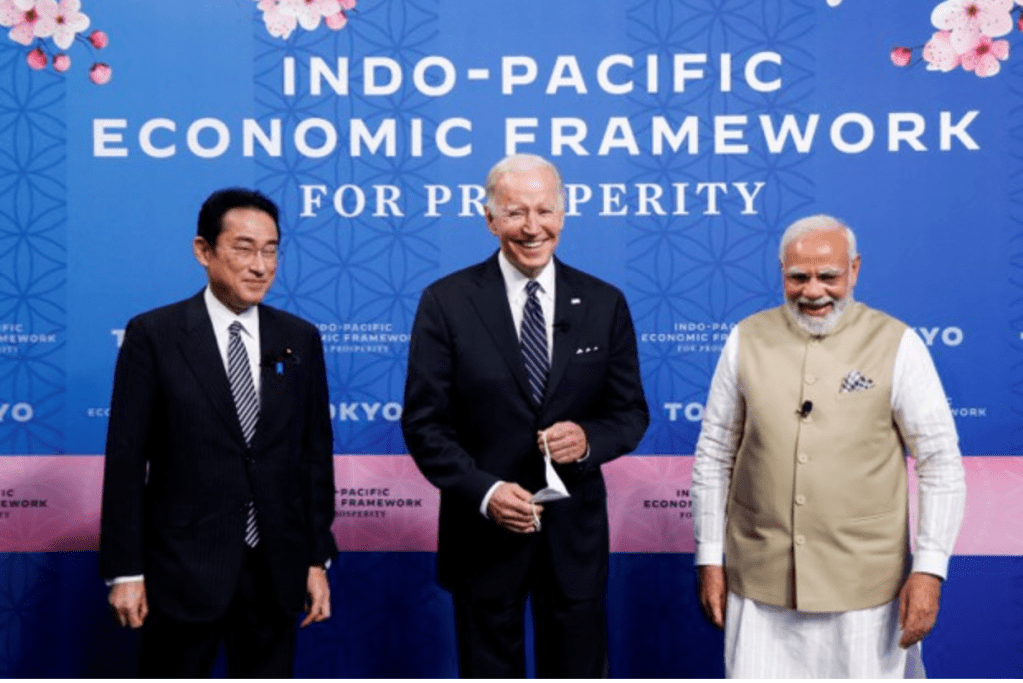
In order to prevent being constrained by China in the global supply chain, the United States and 13 other countries from the “Indo-Pacific Economic Framework” (IPEF) announced a supply chain agreement at the IPEF ministerial meeting held in Detroit on Saturday (27th) local time. This agreement is the first agreement of the 14 participating countries in IPEF since its establishment in May last year, and also the first international agreement on supply chain affairs.
According to foreign media reports, the newly established supply chain agreement emphasizes cooperation in ensuring “alternative supply chains” during crises, so as to avoid situations like China’s restrictions on the export of diesel engine waste oil (sludge) in 2021, which led to tension in its global supply. According to the agreement, countries will establish a supply chain council to strengthen cooperation among participating countries. The council will oversee whether the governments of the 14 participating countries restrict any actions that have a negative impact on the supply chain, expand investment to achieve supply chain diversification, improve logistics, and conduct joint research and development.
IPEF includes the United States, South Korea, Japan, Australia, India, Thailand, Malaysia, Indonesia, Vietnam, the Philippines, Singapore, Brunei, New Zealand, and Fiji. In addition to the recently concluded supply chain agreement, negotiations on three other key areas, namely trade, clean economy, and fair economy, are still ongoing.
China fiercely criticized the establishment of IPEF. The Chinese Communist Party’s media, Global Times, claimed on Sunday (28th) that the IPEF supply chain agreement is a “crisis response network” that lacks a substantive trade agreement. It also stated that most of the countries participating in IPEF are members of the China-led Regional Comprehensive Economic Partnership (RCEP), implying that these countries should abide by the supply chain rules listed in RCEP.
 US-China Relations Updates
Leave a comment