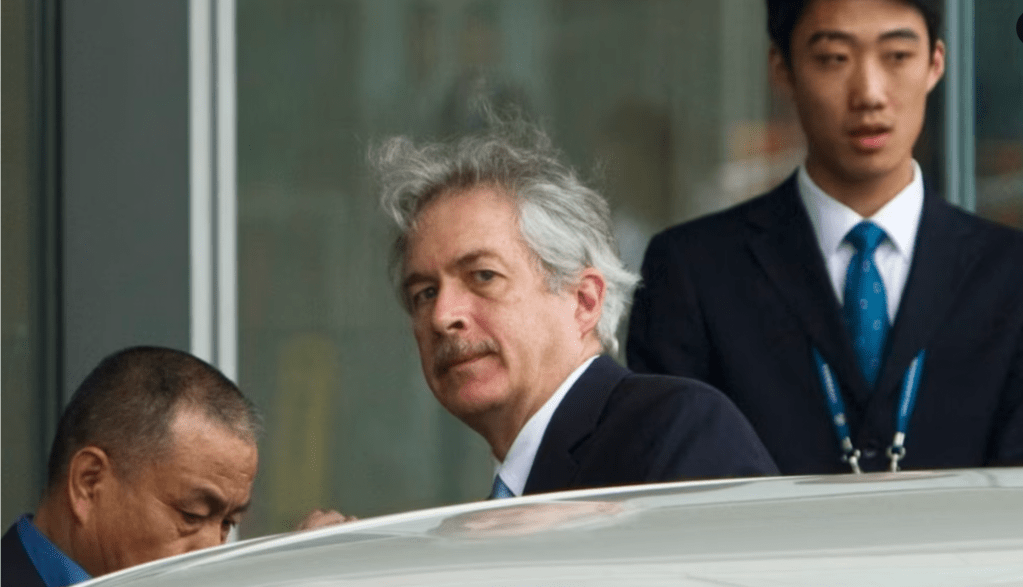
William Burns, the director of the Central Intelligence Agency (CIA), secretly visited China last month and held talks with Chinese officials. Amid a lack of communication between high-level officials from the US and China, President Biden dispatched one of his most trusted senior officials to visit China, indicating the US government’s severe concerns about the sharp deterioration of US-China relations.
The Financial Times, which first reported the news, quoted five sources who said that Burns, who previously served as US Deputy Secretary of State and often undertakes sensitive overseas missions, traveled to China in May for face-to-face talks with Chinese officials. Burns, who became CIA director in March 2021, is also the first career diplomat to serve as CIA director in US history.
A US official also confirmed the Financial Times report to Voice of America.
For some time, the Biden administration has been pushing for interaction between high-level US and Chinese officials to install guardrails for the fiercely competitive US-China relationship, but Chinese interest in such efforts has been limited. As a result, Burns became the highest-ranking US official to visit China since Deputy Secretary of State Wendy Sherman’s visit to Tianjin in November 2021.
The Financial Times reported that both the White House and the CIA declined to comment on the matter, but a US official confirmed that Burns went to China and met with Chinese intelligence officials.
“Last month, Director Burns traveled to Beijing, met with his Chinese counterparts, and emphasized the importance of maintaining open channels of communication in the intelligence field,” the US official said.
Also in May, White House National Security Advisor Jake Sullivan held a two-day, approximately 10-hour meeting with Wang Yi, a member of the Communist Party of China’s Politburo and director of the Central Foreign Affairs Office, in Vienna. However, it was not until after the meeting ended that both sides announced the news of their meeting to the media.
The Financial Times noted that President Biden had also dispatched Burns to Moscow in November 2021 to warn Russian officials not to invade Ukraine, but Russian troops still invaded Ukraine three months later, ignoring the warning.
According to several sources cited by the Financial Times, Biden also sent Burns to the US Congress last year to try to persuade then-House Speaker Nancy Pelosi not to visit Taiwan, but to no avail. After Pelosi’s visit to Taiwan, the People’s Liberation Army conducted large-scale military exercises for several days in multiple sea and air areas around Taiwan, and also abandoned the tacit agreement between the two sides of the Taiwan Strait to use the central line of the Taiwan Strait as the dividing line.
In February of this year, a Chinese high-altitude reconnaissance balloon invaded US airspace and was shot down by the US military, further exacerbating the relationship between the two countries. Although US Secretary of State Blinken announced at the time that he was postponing a planned visit to China, his desire to reschedule the visit has repeatedly been rebuffed by Beijing.
The Financial Times pointed out that the balloon incident made it difficult to implement the plan agreed upon by Biden and Chinese President Xi Jinping during their meeting in Bali, Indonesia in November last year to install bottom lines and guardrails for US-China relations. However, Biden said last month at the Group of Seven (G7) summit in Hiroshima, Japan that US-China relations would soon improve.
The Financial Times reported that Burns visited Beijing before Biden attended the G7 summit.
“As an experienced diplomat and senior intelligence official, Burns is well-suited to engage in dialogues that can contribute to the goal of stabilizing the Biden administration’s relationship with China and installing a bottom line for the relationship,” Bonnie Glaser, a China expert at the German Marshall Fund, told the Financial Times.
Paul Haenle, who previously served as a senior official at the White House National Security Council and now serves as director of the Carnegie-Tsinghua Center for Global Policy, told the Financial Times that one of the biggest advantages of dispatching Burns to Beijing is that he is respected by both Democratic and Republican lawmakers in Congress and is familiar to Chinese officials.
“They know he is a trustworthy interlocutor, and they will welcome the opportunity to quietly talk to him behind the scenes,” Haenle said.
In addition to Secretary of State Blinken’s planned visit to China, which has yet to receive Beijing’s approval, US Defense Secretary Lloyd Austin’s proposal to hold talks with Chinese Defense Minister Wei Fenghe during the Shangri-La Dialogue in Singapore this weekend was also rejected by China. The Financial Times noted that one of the most important reasons why Wei refused to meet with Austin was because the US refused to lift sanctions imposed during Wei’s tenure as Minister of the General Armaments Department of the People’s Liberation Army for purchasing Russian military aircraft and missiles.
However, the Pentagon said that Austin and Wei had a “brief conversation” at an opening dinner for the Shangri-La Dialogue.
“The two leaders shook hands, but there was no substantive exchange,” the Pentagon said.
 US-China Relations Updates
Leave a comment