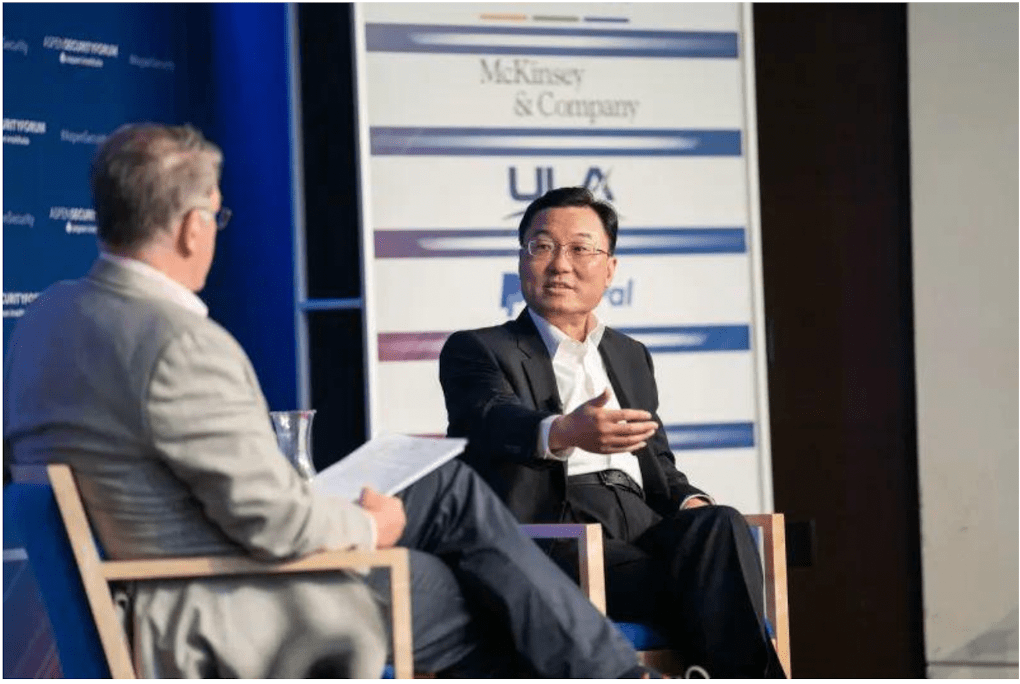
On July 19, 2023, Chinese Ambassador to the United States, Xie Feng, was invited to attend the Aspen Security Forum and hold a special fireside dialogue with Clements, the founding editor of Qiyu News Agency.
Xie Feng pointed out that Taiwan is China’s Taiwan and an integral part of China’s territory that cannot be separated. This is the primary understanding and approach to handling the Taiwan issue. No one values the peace and stability of the Taiwan Strait more than China and hopes for peaceful reunification. The biggest threat to the current peace and stability of the Taiwan Strait comes from two aspects: first, the Taiwan authorities‘ “relying on the US for independence,” refusing to recognize the “1992 Consensus,” and even not wanting to be Chinese; second, some US forces clamoring for “Taiwan making China,” and indulging in the “Taiwan independence” separatist forces’ adventurous provocations. These trends are very dangerous and must be highly vigilant.
Xie Feng emphasized that the Taiwan issue is the most important and sensitive issue in China-US relations. The US should implement President Biden’s commitments not to support “Taiwan independence.” The most fundamental issue now is to adhere to the one-China principle, the most important is to abide by the three Sino-US joint communiques, and the most urgent is to speak and act consistently against “Taiwan independence” adventurous provocations. The urgent task is to resolutely block Lai Ching-te’s rush towards us from the United States.
The Aspen Security Forum is hosted by the Aspen Strategy Group and has a wide range of influence in the United States and abroad. US Secretary of State Blinken and many former politicians, well-known entrepreneurs, think tank leaders, media reporters, and foreign ministers from multiple countries participated in this forum.
Xie Feng, Chinese Ambassador to the US: I hope that the US and China can move towards each other, shorten the negative list, and lengthen the positive list.
Xie Feng stated that the current China-US relationship is facing serious difficulties and severe challenges. Recently, the US has conducted some reflections on its policy towards China. China and the US have had a series of high-level exchanges, conducted frank, in-depth, and constructive communication, especially agreeing to implement the consensus reached at the Bali Summit between the two leaders, which provides an opportunity for the two countries to stabilize their relationship. However, the foundation is still fragile, and the road ahead is still bumpy. The hard-won opportunity is worthy of cherishing and needs to be consolidated.

Xie Feng emphasized that the three principles of mutual respect, peaceful coexistence, and win-win cooperation, put forward by President Xi Jinping, are the fundamental principles for China and the US to manage their relationship correctly in the new era. He hopes that the US and China can move towards each other, striving to stabilize and improve their relationship. Firstly, they should shorten the negative list, take action to remove obstacles and manage differences, properly handle important sensitive issues such as Taiwan according to the principles of the three Sino-US joint communiques, stop sanctioning Chinese entities and individuals, and prevent “black swan” and “grey rhino” events from causing new interference and impact on China-US relations. The US should take action to implement President Biden’s commitments of not seeking to change China’s system, not supporting “Taiwan independence,” not intending to decouple from China, and not intending to obstruct China’s economic development. Secondly, they should lengthen the positive list, strengthen dialogue and expand cooperation with sincerity, starting from small steps, and add positive energy to the development of China-US relations. This includes increasing passenger flights, adjusting travel reminders to China, renewing the China-US Science and Technology Cooperation Agreement, restoring the Congressional Member and Staff Exchange Program under the Mutual Educational and Cultural Exchange Act, holding high-level dialogue on China-US tourism, and facilitating mutual visits of students, scholars, tourists, entrepreneurs, and other people from all walks of life in terms of entry and visas. China and the US once established more than 100 dialogue and exchange mechanisms of various kinds, but they have been frozen by the US since 2018, and the people of the two countries have waited too long. If it is difficult to resume all of them, why not restart 50 or 30 pairs first? Thirdly, they should find and invite people who support China-US relations to speak out and make efforts together, promoting the gradual return of China-US relations to the right track.
Xie Feng said that the Chinese nation is the most peaceful and friendly nation in the world, with no tradition of coercion and no genes of aggression and hegemony. China facilitated the restoration of diplomatic relations between Saudi Arabia and Iran to encourage more countries in the region to shake hands and make peace, aiming to make greater contributions to world peace, stability, and prosperity.
The Aspen Security Forum, hosted by the Aspen Strategy Group, has a wide range of influence in the US and abroad. US Secretary of State Blinken, many government officials, former politicians, well-known entrepreneurs, think tank leaders, media reporters, and foreign ministers from multiple countries, including the UK Foreign Secretary, attended the forum.
Xie Feng stated that when President Xi Jinping met with US Secretary of State Blinken in Beijing, he emphasized that the vast earth is big enough for both China and the United States to develop and prosper together. China respects the interests of the United States and has no intention of challenging or replacing the US. Similarly, the United States should also respect China and not undermine China’s legitimate rights and interests. China has no intention of challenging or replacing any country, nor does it intend to win any competition, but only hopes to become a better version of itself. The “Thucydides Trap” is not a historical inevitability. The world has changed, and the international community should transcend the cold war mentality, group confrontation, and zero-sum game, and pursue cooperation and win-win outcomes, jointly preventing the dead end of great power conflict.
Xie Feng said that someone asked me what kind of flower China will bloom in the future when it becomes strong and prosperous. I want to tell everyone that it will definitely be a flower of peace, cooperation, and common development, just like the beautiful and fragrant peony and rose.
Xie Feng pointed out that we oppose using competition as a cover to launch trade wars and technology wars. China is not afraid of competition and does not shy away from it, but the so-called competition by the US is obviously unfair. Firstly, the US deprived China of the opportunity to participate, such as completely banning Huawei on the unfounded grounds of security, even if Huawei proposed to sign a “no backdoor agreement,” they still would not let you compete? Secondly, the US is not “one-on-one,” but rather rallying allies to “gang up” on China, do they still follow the rules? Thirdly, the US also enacted the “chip ban,” prohibiting the export of chips to China that are less than 14 nanometers, like wearing the most advanced sharkskin swimsuit in a swimming competition while others are only allowed to wear outdated swimsuits, is there any fairness in this?
Xie Feng emphasized that if someone doesn’t provoke me, I won’t provoke them. But if someone provokes me, I will retaliate. China does not want the world to fall into a “iron curtain” or a “silicon curtain,” and no one wants to get stuck in a vicious cycle of “tit-for-tat.” The US has listed more than 1,300 Chinese companies on various sanction lists, causing countless Chinese people to lose their jobs and affecting the livelihoods of countless families. The Chinese people will not stand idly by, and the Chinese government will not sit back and do nothing.
The Aspen Security Forum, hosted by the Aspen Strategy Group, has a wide range of influence in the US and abroad. US Secretary of State Blinken, many government officials, former politicians, well-known entrepreneurs, think tank leaders, media reporters, and foreign ministers from multiple countries, including the UK Foreign Secretary, attended the forum.
 US-China Relations Updates
Leave a comment