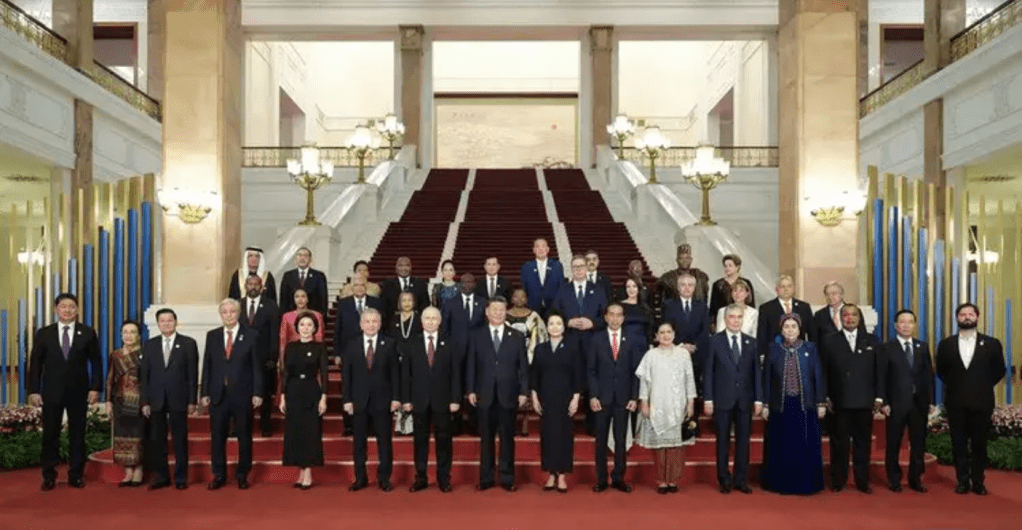
On October 18th, China did something unprecedented. It was the third Belt and Road Initiative (BRI) International Cooperation Summit Forum.
- This was China’s most important diplomatic event of the year. A wave of foreign presidents, prime ministers, and heads of state eagerly came to Beijing.
- It was an absolute “grand gathering.” According to the introduction by Wang Yi, the representative of 151 countries and 41 international organizations attended the forum. Here is an incomplete list of some leaders:
- President Fernández of Argentina,
- President Bachelet of Chile,
- President Sassou of the Republic of Congo,
- President Joko of Indonesia,
- President Tokayev of Kazakhstan,
- President Kenyatta of Kenya,
- Chairman Thongloun of Laos,
- President Battulga of Mongolia,
- President Putin of Russia,
- President Vučić of Serbia,
- President Sirisena of Sri Lanka,
- Chairman Berdimuhamedov of Turkmenistan,
- President Mirziyoyev of Uzbekistan,
- Vietnamese leader Wu Wenshang,
- Prime Minister Hun Sen of Cambodia,
- Prime Minister Madbouly of Egypt,
- Prime Minister Abiy of Ethiopia,
- Prime Minister Orbán of Hungary,
- Prime Minister Marapana of Mozambique,
- Prime Minister Kaka of Pakistan,
- Prime Minister Marape of Papua New Guinea,
- Prime Minister Prayuth of Thailand,
- Vice President Osinbajo of Nigeria,
- UN Secretary-General Guterres…
It covers Asia, Africa, Latin America, and also Europe. Oh, there were also high-level representatives from countries like France, the United Arab Emirates, and Greece.
What does this demonstrate?
It demonstrates the charm, global appeal, and influence of the Belt and Road Initiative. Without such charm, would leaders be so busy coming to Beijing to enjoy the autumn scenery?
But what I value more is this:
- A total of 458 outcomes were achieved, far exceeding the previous two editions. Various initiatives, institutional arrangements, including the establishment of a forum secretariat, were made. With the secretariat, there are mechanisms in place and projects can be implemented effectively. Oh, there was also the Entrepreneur Conference, which resulted in $97.2 billion in commercial contracts.

What does this indicate?
The Belt and Road Initiative is not just about rhetoric; China takes concrete actions. This should be the best news of the year for the world this autumn.
What signal does it convey to the world?
As Wang Yi answered, the forum sent a clear and explicit signal from Beijing to the world: we should unite instead of dividing, cooperate instead of confront, be open rather than closed, and seek win-win results instead of zero-sum games.
This is clearly targeted.
- The most memorable moments during the opening ceremony were the two passages from the speech by Chinese leaders, which resonated strongly.
The first passage:
As long as we view each other as friends and partners, respect, support, and achieve mutual success, giving roses to others will leave fragrance on our hands, and helping others also benefits ourselves. Regarding others’ development as a threat and economic interdependence as a risk will not lead to a better life and faster development for ourselves.
The second passage:
I have said before that the ancient Silk Road achieved enduring fame not through warhorses and spears but through camel caravans and goodwill; not through formidable ships and cannons but through treasure ships and friendship. The joint construction of the Belt and Road Initiative emphasizes that when people join forces to gather firewood, the flames rise high, and mutual assistance leads to far-reaching progress. It advocates for both oneself and others to live well, practices connectivity and mutual benefit, and seeks common development and win-win cooperation.
Then, he proposed the “Three Nos and Three Rejections”:
No ideological confrontation, no geopolitical games, and no group political confrontation. Rejecting unilateral sanctions, rejecting economic coercion, and rejecting “decoupling and disconnection.”
I believe that everyone present was deeply moved by these words.
We should pay particular attention to the international background of this grand event.
Just one day before the opening, another tragic incident occurred in Gaza, where a hospital was attacked, resulting in at least 500 deaths. The scene was heartbreaking.
Palestinian President Abbas angrily canceled his meeting with Biden, and there was worldwide outrage and condemnation of the attack.
Alas, while the world is engulfed in conflict, China is focused on hard work.
Of course, no matter what China does, there will always be some people looking at it with a different perspective. Even before this forum, some Western media claimed that certain leaders would not attend the forum.
Well, look at the scale of attendance now.
I remember quoting a source who said that the scale and quantity were never China’s pursuit for this forum; quality and effectiveness were what mattered. The core purpose of China hosting this forum is to seek common development, and the participants in the joint construction of the Belt and Road Initiative are mostly developing countries. Therefore, the majority of invited leaders are certainly from developing countries.
Of course, China’s attitude is confident and open. For individuals from developed countries, if they come, we welcome them; if they don’t want to come, we don’t mind either.
Certainly, there are understandable reasons. During the days when the forum was held, there were also voices of dissent internationally.
The U.S. Department of Commerce issued so-called final rules further strengthening export restrictions on chips to China.
The Five Eyes alliance issued a joint statement accusing China of using AI for hacking and espionage activities.
Isn’t it interesting? This, from another perspective, further demonstrates the anxiety of certain countries.
Can they not be anxious? Especially after the recent conflict between Israel and Palestine, some countries are in a state of chaos, but China is flourishing, hosting a grand banquet and engaging in discussions on cooperation.
Finally, how should we view this?
Let me summarize it briefly.
First, the Belt and Road Initiative is actually very popular.
That’s why so many leaders from different countries came to Beijing to attend the summit.
An informed source even mentioned a detail: when many countries heard about this year’s summit, even before receiving an invitation, they actively expressed their interest in participating.
What is true win-win cooperation?
This is the real win-win!
Of course, we still need to improve. Therefore, during this summit, Chinese leaders proposed eight actions, aiming to establish a comprehensive and interconnected network for the Belt and Road Initiative, build a green Belt and Road, promote clean governance in the Belt and Road projects, and so on.
Some of these measures are targeted. For example, promoting clean governance in the Belt and Road Initiative. It is unrealistic and unfair to expect such a massive and systematic project to be flawless. However, through various rules and measures, we can ensure that the Belt and Road Initiative goes further and becomes more solid.
Performances related to the Silk Road
Second, it has not been easy for China to reach this point.
A friend forwarded me a passage, which goes like this:
We feel like “the world has changed” over the past few decades, but people from other countries don’t see it that way. A few days ago, I had a conversation with a Malaysian Chinese technical expert who came to Beijing for a conference. He said that in their eyes, the world hasn’t changed much over these decades. The once developed countries are still developed, the once poor countries are still poor, and the previously war-torn regions are still in conflict. The only significant change is the rise of China. The world hasn’t changed; it’s just us…
This statement may be a bit absolute. After all, in the past few decades, many emerging countries have risen. However, no country has risen like China, leaving such a profound impression on the world and fundamentally changing it.
Especially the Belt and Road Initiative, such a grand plan, is truly unprecedented. This should also be considered a significant contribution from China to the world.
In this turbulent world, we should cherish peace, stability, and most importantly, continue to work hard!
Third, we should remain clear-headed and calm.
It may sound cliché, but at this moment, I want to reiterate it.
We should remain clear-headed, aware that the world is far from peaceful. We should be aware that we will undoubtedly face various setbacks and challenges. However, we should remain calm and face these challenges with confidence, as we will surely overcome them.
As long as we follow the right path and stand on the side of historical correctness, we have nothing to fear from any difficulties or obstacles.
The fact that so many foreign leaders happily gathered in Beijing demonstrates the wide circle of friends that China has today. By having more friends and fewer enemies, and by working together with unity, what does China have to fear?
However, China’s future path is still long, so let’s not be arrogant.
 US-China Relations Updates
Leave a comment